Senate Bill 3 Implementation
Stay informed on flood-related topics, including SB 3 implementation, by signing up for the TWDB “Flood” mailing list. For questions related to SB 3 implementation, please send an email to Flood Sirens Program.
In response to the devastating July 2025 floods, the Texas Legislature passed several bills aimed at improving Texas' preparedness for future flood events, including Senate Bill 3 (SB 3), which relates to outdoor warning sirens in flash flood-prone areas. Governor Abbott signed SB 3 into law on September 5, 2025.
SB 3 directs the Texas Water Development Board (TWDB) to assess the 30 counties included in the disaster declaration issued by the Governor in July 2025 to identify flash flood-prone areas with a history of consistent or severe flooding where outdoor warning sirens are warranted.
The bill requires:
- the appropriate municipality or county within those areas identified by the TWDB to install, maintain, and operate an outdoor warning siren system—which is defined to include all components essential to the system's functionality,
- the TWDB to facilitate the development of best management practices and guidance for the operation of outdoor warning sirens, and
- the TWDB to develop rules relating to requirements for outdoor warning systems in flash flood-prone areas.
SB 3 also requires the Office of the Governor to establish and administer a grant program to assist municipalities, counties, and other governmental entities with the costs of installing outdoor warning sirens. In November 2025, the Office of the Governor delegated this responsibility to the TWDB. The grant program will be developed in the weeks and months to come, and as details regarding the program become available, they will be added to this page.
Senate Bill 5, also passed by the Texas Legislature and signed by the Governor on September 18, 2025, appropriated funding from the state's economic stabilization fund to the Office of the Governor for a variety of purposes related to disaster relief and preparedness. There is $50 million in allocated funding for grants to assist counties, municipalities, and other local governmental entities within the 30 counties identified by the disaster declaration to establish and implement a system of flood warning sirens and flood gages and to purchase other related equipment. In November 2025, the Office of the Governor entered into an agreement with the TWDB to administer the grant program outlined in SB 3.
The TWDB is working to implement SB 3 on a highly accelerated timeline, and updates will be made to this webpage as more resources and information become available. Stay informed on flood-related topics, including SB 3 implementation, by signing up for the TWDB “Flood” mailing list. For questions related to SB 3 implementation, please send an email to Flood Sirens Program.
Publications
- Senate Bill 3 Implementation Board Memo - On December 16, 2025, the TWDB's Board was briefed on the SB 3 implementation plan.
- Senate Bill 3 Grants Program Board Memo - On December 16, 2025, the TWDB's Board approved the Executive Administrator to negotiate and execute contracts for Senate Bill 3 Outdoor Warning Siren Grants. The memo provides additional information regarding the grant agreements.
- Senate Bill 3 (SB3) TWDB Rules for Public Comment Board Memo - On January 22, 2026, the TWDB's Board authorized the publication of the new 31 TAC Chapter 378 for public comment to implement the requirements of SB 3.
- Senate Bill 3 Flash Flood Prone Areas Board Memo - On March 3, 2026, the TWDB’s Board approved the identification of areas in the disaster declaration issued by the governor in response to the July 2025 floods that have a history of consistent or severe flooding and may warrant the installation of one more outdoor warning sirens. The memo provides additional information regarding the identification process.
- Flash Flood Warning Siren Guide v1.1 - Senate Bill 3 requires the TWDB to develop best management practices and guidance for the installation, maintenance, and operation of outdoor warning sirens—including requirements for those systems. This guide outlines requirements that all systems must meet and includes broader recommendations for effective system design and implementation.
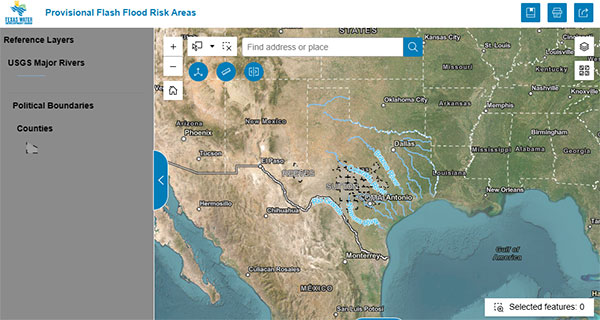
- User Guide for the Provisional Flash Flood Risk Area Mapping Tool - This document provides helpful information and step-by-step instructions on using the mapping tool, as well as guidance on how counties or their authorized representatives can request map edits where areas for updates or corrections are identified.
- Memorandum: Identification of Flash Flood-Prone Areas that warrant Outdoor Warning Sirens - Senate Bill 3 requires the TWDB to identify areas within the 30 counties that have a history of consistent or severe flooding and may warrant the installation, maintenance, and operation of one or more outdoor warning siren systems. This document goes through the methodology of how the areas were identified.
Provisional Flash Flood Risk Areas Map
Download the SB3 ArcGIS Project Package
Download the SB3 file geodatabase
Resources
- Senate Bill 3 Sample Resolution - Each county included in the July 2025 Flood Disaster Proclamation is required to submit a resolution from its Commissioners Court authorizing acceptance of outdoor warning siren system funding and approval to enter into an agreement with the TWDB. The form provided serves as an example resolution. Counties may use their own form or template for the resolution and are not required to use this form. Counties should include substantially similar content to authorize a representative to execute the grant agreement and accept the funds on the County's behalf. The TWDB authorized an initial grant amount up to $1 million and allowance for an additional $250,000 with approval from the Executive Administrator. The sample resolution authorizes the full $1.25 million, and for certain amendments, as an example for Counties that choose to authorize the full amount now. Alternatively, if they would prefer to require Commissioners Court action for any amendments or increases, they could do so.
- Senate Bill 3 Project Plan Template (Revised September 2026) - To receive funding through the Senate Bill 3 Grants Program, eligible counties are required to complete the SB 3 Project Plan Template for each proposed project. Please email completed project plant templates to Flood Sirens Program. Note that cumulative amounts by county over $1,000,000 are subject to the approval of the TWDB Executive Administrator, and amounts over $1,250,000 are subject to the approval of the TWDB governing Board. Additionally, counties must have completed the TWDB Vendor Set-up and Direct Deposit forms before advances or reimbursements can be made. Vendor Set-up and Direct Deposit forms must be submitted by email to Vendor Setups.
- Senate Bill 3 (SB 3) - SB 3 directs the TWDB to 1) assess the 30 counties included in the July 2025 disaster declaration to identify flash flood-prone areas, 2) facilitate the development of best management practices and guidance for the operation of outdoor warning sirens, and 3) develop rules relating to requirements for outdoor warning systems in flash flood-prone areas. The TWDB is also responsible for the development of the grant program described in SB 3, as the Office of the Governor has delegated this responsibility to the agency.
- Senate Bill 5 (SB 5) - SB 5 appropriated $50 million in funding from the state's economic stabilization fund to the Office of the Governor for grants to assist entities within the 30 counties identified by the disaster declaration. This funding must be used to establish and implement a system of flood warning sirens and flood gages and to purchase other related equipment. The Office of the Governor has entered into an agreement with the TWDB that empowers the agency to administer these grants.
- July 2025 Flood Disaster Proclamation - On July 22, 2025, the Governor issued a disaster proclamation for 30 counties impacted by flooding in early July 2025. These are the same counties impacted by SB 3.
- Flood Early Warning Systems Guidance - Effective Flood Early Warning Systems (FEWS) are essential to reducing flood impacts on Texas communities. The TWDB developed this guidance document to provide stakeholders with a resource to support FEWS planning, financing, deployment, and management.
- Alternative Flood Early Warning Systems Guide - This guide was developed to provide communities with information on how to select, install, and operate a commercially available and scalable low-cost flood sensor (LCFS) flood warning system that provides real-time flood alert communications at roadways.
- SB 3 Flood Sirens Grants Invoice Portal User Guide - The TWDB is implementing a new invoice packaging tool designed to assist counties in submitting receipts so that the TWDB can expedite reimbursement of eligible SB 3-related expenditures. This guide explains how to use the tool.
SB 3 Stakeholder Meeting Recordings
Frequently Asked Questions (FAQs)
Keyboard navigation for Q & A: First, use Arrow Keys to navigate up and down the sections. Then, use either Enter or Space key to open the selected section. Finally, use the Tab key to toggle the links within each section.
Funding eligibility is limited to county governments within the disaster declaration issued by the Governor in July 2025. The disaster declaration includes the following counties: Bandera, Bexar, Burnet, Caldwell, Coke, Comal, Concho, Edwards, Gillespie, Guadalupe, Hamilton, Kendall, Kerr, Kimble, Kinney, Lampasas, Llano, Mason, Maverick, McColloch, Menard, Real, Reeves, San Saba, Schleicher, Sutton, Tom Green, Travis, Uvalde, and Williamson counties.
This grant funding is intended to support the installation of outdoor warning siren systems, including flood gages and all other components essential to the function of the system. These essential components can include physical infrastructure, such as rain gages, flood gages, and solar panels, as well as non-physical components such as education, outreach, and training.
The county may work with municipalities and other governmental entities to determine necessary projects and project sponsors, to install the required outdoor warning siren systems, and to transfer the funds to do so. This should be done through a written agreement.
Senate Bill 3 does not allow for maintenance or equipment upkeep as part of the siren grant program, so either the county or another entity that contracts with the county will be responsible for those expenses.
The Senate Bill 3 Sample Resolution serves as an example resolution. Counties may use their own form or template for the resolution and are not required to use this form.
Counties should include substantially similar content in order to authorize a representative to execute the grant agreement and accept the funds on the County's behalf. The TWDB's governing Board authorized an initial grant amount of $1million and authorized the Executive Administrator to increase that amount by $250,000 if needed. The sample resolution includes authorization for the full $1.25 million and authorization for certain amendments as an example for Counties to use if they so choose. If they would prefer to require Commissioner's Court action for amendments or increases, they could do so. The “Engineer” and “Legal Counsel” lines may be amended or left blank according to the needs of the County. If those consultants are not designated yet, the County may provide that information at a later date. If the County wishes to designate any other type of consultant or representative, it can add a line for that consultant.
No, project plans submitted to the TWDB do not need to be certified by a P.E. However, local requirements may necessitate that certain aspects of the project plan are certified by a P.E. For example, the local permitting required as part of the outdoor warning siren system design process may require P.E. Certification.
Because of the expedited nature of these funds, the TWDB may reduce the amount of financial assistance available under the grant agreement if the County fails to submit approvable Project Plans for the full $1,000,000 initial amount awarded under this Agreement by December 31, 2026. For the same reason, counties seeking consideration for additional grant funding beyond $1,250,000 are strongly encouraged to submit project plans to the TWDB by October 30, 2026, including estimates of any additional funding needed to implement flood siren systems. This will give the TWDB additional time to evaluate project plans, assess funding needs across impacted communities, and ensure the most responsible use of remaining grant funds. We encourage counties to submit their project plans as soon as possible and to reach out tot he TWDB with any questions. Additionally, due to the expiration of the appropriated funds, all final invoices must be submitted to the TWDB for reimbursement by August 1, 2027.
Yes, counties will be able to request reimbursements for eligible costs incurred after September 5, 2025, the effective date of Senate Bill 3.
The TWDB may enter into a grant agreement with each county for a maximum initial amount of $1 million with an allowance to increase that amount by $250,000; any additional increases would require approval by the TWDB's governing Board.
No, counties will not be required to use particular vendors.
The TWDB will not have an approved vendor or contractor list. Vendor and contractor selection is up to each county (and those who they partner with via written agreement
The Texas Department of Information Resources (DIR) put out a Request for Offer (RFO) to identify vendors that could provide Flood Early Warning System technology solution products and services. The RFO closed in January 2026. The awarded contracts can be found by searching for the RFO number on the DIR website: DIR-CPO-TMP-608. As of May 2026, there are three active FEWS contracts. Additional contracts will be available on the same website as they are awarded.
Yes, grant administration and project management costs are eligible expenses. These costs should be included in the project plan.
Available guidance from the Texas Department of Transportation (TxDOT), Texas Manual on Uniform Traffic Control Devices (TMUTCD), the National Weather Service (NWS), and the Federal Highway Administration (FHWA) indicates that sirens are generally considered supplemental warning devices at low water crossings, rather than primary traffic control measures. Current best practices emphasize visual warning and closure systems - including signs, flood gauges, flashing beacons, automated gates, and roadway barriers - because these measures provide direct, unambiguous information to motorists. When reviewing project plans, TWDB staff will consider sirens proposed at low water crossings if they are part of a comprehensive system and not the sole means of warning.
It is anticipated that the TWDB's governing Board will consider the identification of flash flood-prone areas at their regular meeting on March 3, 2026.
The Flash Flood Warning Siren Guide was published on January 27, 2026.
Include your total funding request in the project plans. If your county's project plans total more than $1 million, the EA may approve an additional $250,000 through a grant agreement amendment. If your project plans total more than $1.25 million, that grant agreement amendment would be subject to Board approval.
This grant program does not include any specific procurement or environmental review requirements. Recipients will need to follow their typical state and local requirements.