Agricultural Resources
Agency Resources
- The Water Conservation Advisory Council has an agricultural workgroup that evaluates metrics for agriculutral water uses, identifies trends in agricultural water conservation, and engages in other activities.
- The Texas Geographic Information Office (TxGIO) has current or historical aerial imagery of your property.
- The TWDB Map Catalog has pre-made maps available for download or print.
- The TWDB groundwater educational videos shows the aquifers of Texas, how they work, and how we model groundwater availability.
- Texas Alliance for Water Conservation Solutions is intended to provide a simple web-based management decision tool and an ET (evapotranspiration) tool that can aid in improved irrigation management.
- The Producer Manual for South Texas Irrigators discusses irrigation economic issues, scheduling, technologies and best management practices, and water quality issues. The Irrigation Training Program from the Texas Water Resources Institute discusses the development of a core manual and training conferences designed to meet regional needs.
- Irrigation for Small Farms Manual provides an overview of crop water requirements, soil moisture management, irrigation water quality issues, and irrigation technologies.
-
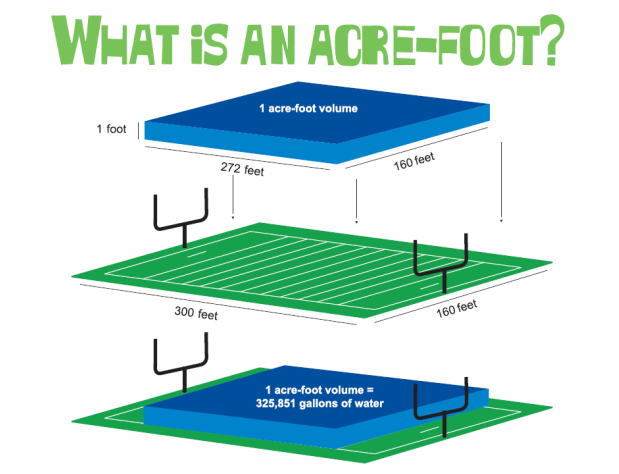
In agriculture, water volume is often discussed in terms of Acre-Feet: one acre of land covered in water one foot deep. One Acre-Foot (or 1 AF) of water equals about 325,851 gallons or 43,560 cubic feet of water. (An Olympic-sized swimming pool holds about 630,000 gallons or almost 2 AF of water.) Download the Poster
Statewide External Resources

The Texas A&M Irrigation Technology Center(ITC) promotes efficient irrigation and water conservation while maintaining profitable agricultural production and quality urban landscapes. Housed at Texas A&M University-San Antonio, the program offers training courses & workshops.
Texas A&M AgriLife includes teaching, research, extension education, laboratory, and forestry facilities throughout Texas. Through collaborations between the TAMU system and public and private entities, AgriLife is focused on protecting our environment, feeding our world, growing our economy, improving our health, and enriching our youth.The AgriLife Learn is a catalog of pubications and merchandise on agricultural.

Water My Yard shows how a healthy landscape actually requires less water than you may think! The site provides irrigation recommendations for warm season turf grasses such as St. Augustine, Bermuda, Zoysia, and Buffalo. At this time data are only available for these cities: Allen, Bryan, College Station, Farmersville, Forney, Frisco, Garland, Irving, McKinney, Mesquite, Plano, Princeton, Richardson, Rockwall, Royse City, and Wylie.
The Texas Agricultural Irrigation Association (TAIA) brings members from the irrigation industry, research, education, and production agriculture together to work toward water conservation and improved profitability in irrigated agriculture. TAIA also awards an in-state scholarship for a full-time college student pursuing an agriculture major.
The Texas Alliance of Groundwater Districts (TAGD) was formed to further the purpose of groundwater conservation and protection activities. TAGD provides groundwater conservation districts (GCDs) the opportunity to exchange ideas and develop programs for the management, conservation, protection, and development of groundwater in Texas. Find your GCD.
The Texas Department of Agriculture has been promoting production agriculture, consumer protection, economic development, and healthy living since 1907. Did you know that one of every seven working Texans is in an agriculture related job? Find out more and learn how Agriculture is your Culture.
The Texas State Soil and Water Conservation Board (TSSWCB) is the state agency that administers Texas' soil and water conservation law and coordinates conservation and nonpoint source pollution abatement programs throughout the State. Headquartered in Temple, Texas, the TSSWCB offers technical assistance to the state's 216 soil and water conservation districts. Which district serves you?
The Texas Water Resources Institute (TWRI) works to foster and communicate research and educational outreach programs focused on water and natural resources science and management issues in Texas and beyond. Read about how low pressure center pivot systems improve both energy and water use efficiency in "Status and Trends of Irrigated Agriculture in Texas".
Nationwide External Resources
The Irrigation Innovation Consortium (IIC) is a collaborative research effort to accelerate the development and adoption of water and energy efficient irrigation technologies and practices through public-private partnerships. The Consortium has five founding university partners and eight founding industry partners. Initial participants are working to create a platform for other universities, federal agencies and the private sector to work together on the critical water challenges facing agriculture, municipalities and industry.

The Irrigation Association (IA) is the leading membership organization for irrigation equipment and system manufacturers, distributors, designers, consultants, and end users. The IA is committed to promoting efficient irrigation technologies, products, and services to ensure long-term sustainability of water resources for future generations.
The United States Department of Agriculture- Farm Service Agency's (USDA-FSA) mission is to equitably serve all farmers, ranchers, and agricultural partners through the delivery of effective, efficient agricultural programs for all Americans. The ultimate benefit will be improved economic viability for family farmers and ranchers. Visit FSA's online knowledge base to find answers to commonly asked questions.

The United States Department of Agriculture-Natural Resource Conservation Service (USDA-NRCS) works with landowners through conservation planning and assistance to benefit the soil, water, air, plants, and animals for productive lands and healthy ecosystems. Find your local Texas field office.
The USDA-NRCS also has a website dedicated specifically to understanding soils. There you can learn about describing and sampling soils, as well as explore your soils in detail with the Web Soil Survey - an interactive online update to the old Soil Conservation Service county soil surveys.
The United States Department of Agriculture- Sustainable Agriculture Research & Education (USDA-SARE) program strives to advance innovations that improve profitability, stewardship, and quality of life by investing in groundbreaking research and education. The southern region includes Texas, and producers can find new ideas and proven technologies on this site.